
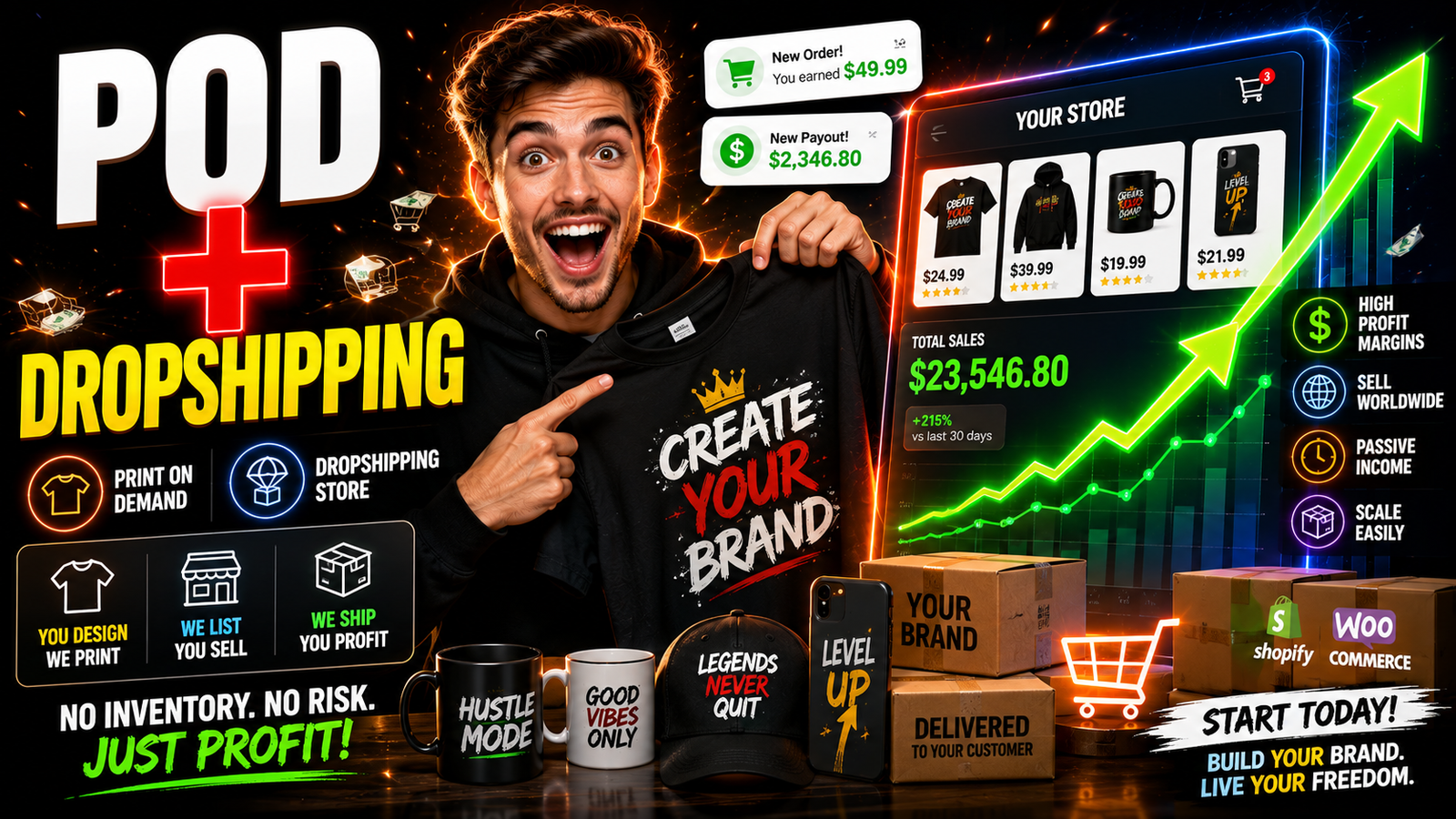
Both models let you sell products without holding inventory, but they work quite differently in practice — print on demand centers on custom designs, while dropshipping centers on sourcing and reselling existing products. Here’s how each actually works.
Quick Comparison
| Factor | Print on Demand | Dropshipping |
|---|---|---|
| Product type | Custom-designed items (shirts, mugs, posters) | Existing products sourced from suppliers |
| Startup cost | Very low | Low-moderate |
| Profit margins | Moderate | Variable, often thinner |
| Design/creative skill needed | Yes, or willingness to outsource design | No |
| Supplier research needed | Minimal — platforms handle production | Significant — supplier reliability varies widely |
| Shipping times | Moderate (production + shipping) | Variable, often longer if sourcing overseas |
Print on Demand: How It Works
| Step | What Happens |
|---|---|
| 1. Create a design | You (or a designer you hire) create artwork for products |
| 2. Upload to a POD platform | Connect designs to products like shirts, mugs, or phone cases |
| 3. List for sale | Products appear in your online store or marketplace listing |
| 4. Customer orders | The POD platform automatically prints and ships — you never handle inventory |
| 5. You keep the margin | The difference between your listed price and the platform’s base cost |
Top Print on Demand Platforms
| Platform | Best For | Official Site |
|---|---|---|
| Printful | Wide product range, Shopify/Etsy integration | printful.com |
| Printify | Competitive pricing, multiple print providers | printify.com |
| Redbubble | Built-in marketplace audience | redbubble.com |
| Etsy (with POD integration) | Strong organic search traffic for niche designs | etsy.com |
Dropshipping: How It Works
| Step | What Happens |
|---|---|
| 1. Find a supplier | Source products through a platform or direct supplier relationships |
| 2. List products in your store | Set your own retail pricing above supplier cost |
| 3. Customer orders | Order details are forwarded to the supplier |
| 4. Supplier ships directly to customer | You never handle the physical product |
| 5. You keep the margin | Difference between your retail price and supplier cost |
Top Dropshipping Tools & Platforms
| Platform/Tool | Purpose | Official Site |
|---|---|---|
| Shopify | Store platform most dropshippers build on | shopify.com |
| Oberlo (legacy)/DSers | Supplier sourcing and order automation | dsers.com |
| AliExpress | Common supplier source | aliexpress.com |
| Spocket | Faster-shipping US/EU supplier network | spocket.co |
Profit Margin Comparison
| Model | Typical Margin Range | Key Margin Factor |
|---|---|---|
| Print on demand | Moderate — platform base costs are relatively fixed | Design uniqueness and pricing strategy |
| Dropshipping | Often thinner, especially in saturated niches | Supplier cost negotiation and niche selection |
Choosing a Niche for Either Model
| Good Niche Signals | Weak Niche Signals |
|---|---|
| Specific, identifiable audience with clear interests | Extremely broad, generic products |
| Products with genuine emotional or identity appeal (for POD specifically) | Purely commodity items with no differentiation |
| Manageable competition level | Oversaturated categories dominated by major sellers |
Common Mistakes in Both Models
| Mistake | Better Approach |
|---|---|
| Choosing products with no real audience research | Validate demand before building out a full store |
| Ignoring supplier reliability (dropshipping specifically) | Order samples yourself before committing to a supplier |
| Underpricing to compete on price alone | Differentiate through design, niche focus, or bundling instead |
| Neglecting customer service expectations | Both models still require responsive support despite not handling fulfillment directly |
Realistic Expectations
| Model | Time to First Sale | Time to Meaningful Income |
|---|---|---|
| Print on demand | Weeks, with marketing effort | Several months of consistent design output and promotion |
| Dropshipping | Weeks, with ad spend or organic marketing | Several months, often requires paid advertising investment |
Final Takeaway
Print on demand suits people with design sensibility or a strong niche identity angle, while dropshipping suits people more focused on product sourcing and marketing over creative design work. Both require real marketing effort — neither is genuinely passive from day one, despite how they’re sometimes marketed.